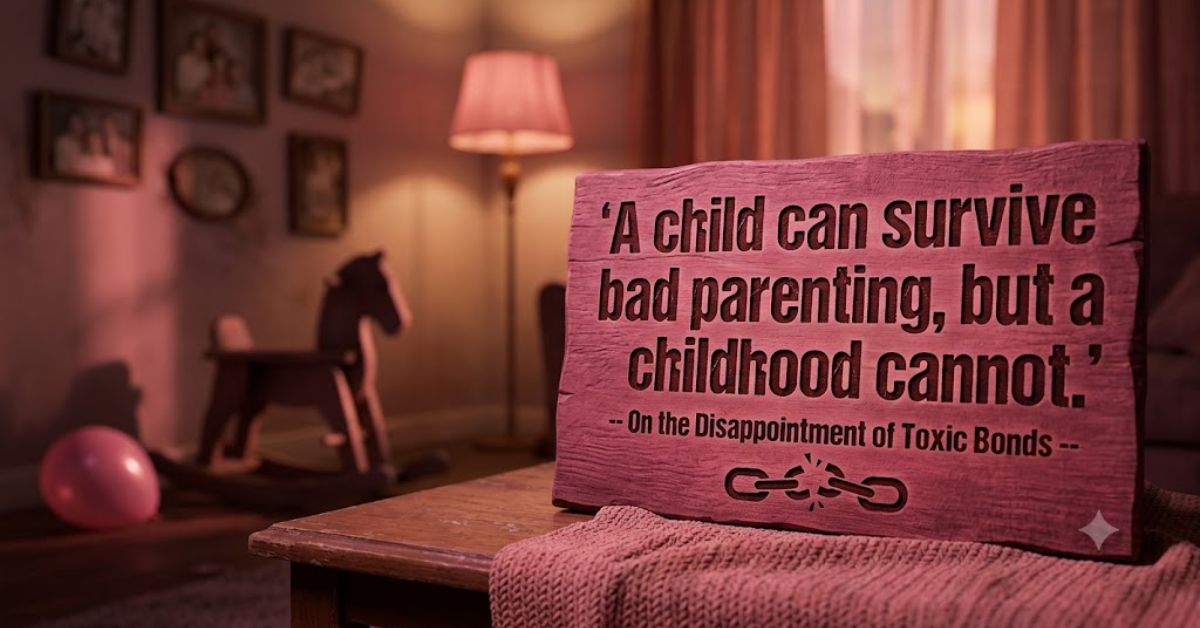
Growing up with a difficult parent leaves marks that don’t always show on the outside. If you’ve spent years searching for words that describe what you lived through, bad parents quotes can feel like someone finally understands. This collection of 355 bad parents quotes and sayings brings together funny, sarcastic, sad, and healing lines for anyone who grew up with a toxic, selfish, or emotionally unavailable parent — plus practical, therapist-informed steps for moving forward in a healthier direction.
In this guide, you’ll find quotes organized by mood and situation — from toxic parent quotes and selfish mother quotes to messages from grown sons and daughters. You’ll also learn practical ways to deal with bad parents, set boundaries, build a chosen family, and finally focus on healing instead of waiting for an apology that may never come. Whether you need validation, a laugh, or a roadmap forward, this article has you covered, so keep reading to find the words that finally match your story and the strategies that can help you move past it.
Focus On What You Can Control
You cannot rewrite your childhood, and you cannot force a parent to change. What you can control is how you respond today, the boundaries you set, and the life you choose to build going forward. This mindset shift is often the real turning point for adult children of difficult parents — trading the exhausting hope of changing someone else for the achievable goal of changing yourself. Psychologists often call this an internal locus of control, and building it is one of the most protective habits you can develop after a chaotic childhood. These quotes are reminders that your energy belongs to your own healing, not their behavior, and that steady, quiet progress still counts as progress even when nobody else notices it.
- “You can’t control their choices, but you can always control your peace.”
- “Stop waiting for them to change; start changing what you do next.”
- “Your healing doesn’t depend on their apology arriving.”
- “Redirect the energy you spend hoping into energy spent healing.”
- “You own your reactions even when you didn’t own your childhood.”
- “Focus on the garden you’re growing, not the storm they created.”
- “The only behavior you can fix is your own.”
- “Peace begins the moment you stop trying to manage them.”
- “Control what you can; release the rest without guilt.”
- “Your future isn’t obligated to repeat your past.”
- “Energy spent trying to control them is energy stolen from your own life.”
- “The version of you that heals doesn’t need their permission to start.”
- “What you tolerate today shapes what you’ll accept tomorrow, so choose wisely.”
Read more.Josh Connor Financier Net Worth 2026: Bio, Age, Career Explained
Funny Bad Parents Quotes And Sayings
Sometimes humor is the healthiest coping tool available. Laughing at the absurdity of a chaotic childhood doesn’t minimize the pain — it just makes it survivable. Funny bad parents quotes let you poke fun at the guilt trips, the mixed messages, and the “back in my day” lectures without pretending everything was fine. Many people use these as captions, journal entries, or icebreakers with siblings who lived through the same thing. A little dark comedy can be surprisingly therapeutic, and it often opens the door to more honest conversations than a serious discussion ever could, especially between siblings comparing notes for the first time as adults.
- “My childhood had more plot twists than a soap opera.”
- “I didn’t rebel, I just finally read the terms and conditions.”
- “Some families have traditions, mine had emotional cliffhangers.”
- “My parents weren’t strict, they were just plot devices for my therapy bills.”
- “I’m not saying my childhood was rough, but my toys were mostly excuses.”
- “We didn’t have family meetings, we had ambushes with snacks.”
- “My parents gave me a great sense of humor, mostly out of necessity.”
- “Growing up in my house was basically improv theater with consequences.”
- “I learned sarcasm as a second language before I learned math.”
- “My parents’ parenting style could best be described as ‘winging it, loudly.'”
- “Every family reunion doubled as an unlicensed group therapy session.”
- “I turned out fine, said no one who actually grew up like me.”
- “My childhood taught me negotiation skills before I could tie my shoes.”
- “We didn’t do bedtime stories, we did cliffhangers about who was in trouble.”
Selfish Mothers Quote
A selfish mother often centers her own needs, image, or comfort ahead of her child’s emotional wellbeing. That doesn’t erase the love a child may still feel, but it does explain the confusion of growing up never quite sure where you stood. Selfish mother quotes help name a dynamic that’s often dismissed as “she did her best,” when in reality the child was doing most of the emotional labor. These quotes validate that experience without demanding you stop loving her, while also giving language to a pattern many daughters and sons spend years trying to explain to friends who simply had a different kind of mother growing up.
- “A mother’s love shouldn’t come with an invoice attached.”
- “She gave me life, then billed me for it emotionally forever.”
- “Some mothers raise children, others raise an audience for themselves.”
- “Her needs always outranked mine, and I mistook that for normal.”
- “I was the supporting character in my own mother’s story.”
- “A selfish mother teaches her daughter to shrink before she teaches her to shine.”
- “She loved the idea of motherhood more than the practice of it.”
- “I learned to mother myself because she was busy mothering her image.”
- “Her competitiveness with me felt like love wearing a disguise.”
- “I stopped performing for her applause and started living for myself.”
- “She wanted a reflection of herself, not a daughter with her own path.”
- “I learned to ask for less so she’d have less to resent.”
- “Her jealousy toward me felt strange to carry as a child.”
Seek Support
Nobody should carry the weight of a difficult parent alone. Whether it’s a therapist, a support group, a trusted friend, or an online community of people with similar stories, support turns an isolating experience into a shared one. Seeking support isn’t weakness — it’s often the fastest path toward clarity, validation, and a plan you can actually follow. Support systems also help interrupt the isolation that toxic families often depend on to keep their patterns unchallenged, since dysfunction tends to survive best in secrecy and silence. These quotes speak to the relief of finally being believed and understood by someone outside the family system.
- “You don’t have to explain trauma to someone who’s lived it too.”
- “A good therapist can undo years of gaslighting, one session at a time.”
- “Support groups exist because shared pain shrinks when it’s spoken aloud.”
- “Asking for help isn’t betrayal, it’s survival.”
- “The right people will believe you the first time you tell them.”
- “You were never meant to carry this story in silence.”
- “Healing accelerates the moment someone finally says, ‘that wasn’t okay.'”
- “Find your people; they’ll hold what your parents dropped.”
- “Community can rebuild the trust your family broke.”
- “You deserve witnesses to your healing, not just your pain.”
- “Isolation kept the secret; connection is what finally breaks it.”
- “The right support system makes healing feel possible instead of impossible.”
- “One person believing you can undo years of feeling invisible.”
Sad Toxic Parents Quotes And Sayings
There’s a particular grief in mourning a parent who is still alive — grieving the relationship you needed but never got. Sad toxic parent quotes capture that quiet heartbreak: the birthdays that were forgotten, the achievements that went unacknowledged, the love that always seemed to have conditions attached. These words don’t fix anything, but they do give shape to feelings that are hard to explain to people who had normal childhoods, and they often bring an unexpected sense of relief simply because someone else has finally put the ache into words you couldn’t find on your own.
- “I mourned a parent who was still alive the whole time.”
- “Some children grieve a relationship that never actually existed.”
- “I kept hoping for a version of you that never showed up.”
- “The saddest part wasn’t the yelling, it was the silence afterward.”
- “I learned to celebrate my wins quietly, because you never did.”
- “You were in every photo of my childhood and absent from all of it.”
- “I still flinch at kindness because I confused it with a setup.”
- “Grief doesn’t always start at a funeral; sometimes it starts at birth.”
- “I spent years missing something I never technically had.”
- “The child in me is still waiting by a door that never opened.”
- “I learned to grieve quietly, because my sadness was never welcome either.”
- “Some wounds don’t scar over, they just learn to stay hidden.”
- “I learned to comfort myself, since comfort never came from you.”
Read more.Sarah Winchester Net Worth at Death: Historical Records & Estate Facts (2026)
Establish Healthy Boundaries
Boundaries are not punishments — they are the fence line that protects your peace. With a bad parent, boundaries might mean limiting contact, refusing to discuss certain topics, or simply leaving a conversation the moment it turns disrespectful. Healthy boundaries communicate clearly what you will and won’t accept, and they hold steady even when a parent pushes back, guilt-trips, or tests the limit. Boundaries are an act of self-respect, not rebellion, and the discomfort you feel enforcing them the first few times usually fades once the new pattern becomes familiar to both sides of the relationship.
- “Boundaries are the love language you give yourself.”
- “Saying no to them is saying yes to your peace.”
- “A boundary isn’t a wall, it’s a door with a lock you control.”
- “You’re allowed to love someone from a distance.”
- “Enforcing a boundary once means enforcing it every single time after.”
- “Guilt doesn’t mean the boundary is wrong; it means it’s working.”
- “You can be family and still be limited access.”
- “Boundaries protect the relationship you can still have.”
- “A boundary you explain once doesn’t need to be re-argued forever.”
- “Consistency turns a boundary into a habit they eventually respect.”
- “A boundary tested isn’t a boundary failed, it’s a boundary working.”
- “You don’t owe anyone unlimited access just because they’re related to you.”
- “A boundary respected is a relationship that might actually survive.”

Quotes And Sayings: I Am A Bad Parent / Mother / Father
Self-awareness is rare and often the first genuine step toward change. These quotes are written from the perspective of a parent honestly admitting their failures — not as an excuse, but as accountability. If you’re a parent worried about repeating harmful patterns, these lines can serve as both a mirror and a starting point. Acknowledging “I was not the parent my child needed” takes courage most toxic parents never find, and simply reaching that level of honesty already sets you apart from the pattern you may have grown up inside yourself.
- “I was the parent my child had to recover from.”
- “I gave my children a childhood I’m still apologizing for.”
- “I mistook control for care, and my kids paid for it.”
- “Admitting I was a bad parent is the only good decision I’ve made.”
- “My children learned resilience because I gave them no other choice.”
- “I wasn’t cruel on purpose, but the damage was real anyway.”
- “Sorry isn’t enough, but it’s the only place I can start.”
- “I raised my children reactively instead of intentionally, and I regret it.”
- “I confused discipline with fear, and my kids felt the difference.”
- “Owning my failures is harder than hiding from them, but it’s necessary.”
- “I am learning, late but sincerely, how to actually show up.”
- “My children deserve better than the parent I’ve been so far.”
- “I am trying, imperfectly, to become the parent I never had.”
Depression Toxic Parents Quote
Toxic parenting and depression are deeply connected. A child who grows up walking on eggshells, chasing approval, or absorbing a parent’s anger often internalizes that pain as their own fault. These quotes speak directly to the link between childhood dysfunction and adult mental health struggles, validating that depression rooted in family trauma is real, common, and not a personal weakness. Naming that connection out loud is often the moment survivors stop blaming themselves for feelings that were never really theirs to begin with, and start understanding their sadness in proper context.
- “Depression is sometimes just childhood, delayed and unresolved.”
- “I learned sadness before I learned my alphabet.”
- “Your toxic home didn’t just hurt my feelings, it rewired my brain.”
- “I spent years medicating a wound I couldn’t name.”
- “Growing up unseen taught me to disappear even from myself.”
- “The heaviness I carry started at your dinner table.”
- “I wasn’t born anxious; I was raised into it.”
- “Healing from you looks a lot like learning to breathe again.”
- “My sadness has a history, and most of it starts with you.”
- “Recovery means unlearning what your house taught me to believe about myself.”
- “The weight I carry now was handed to me long before I could refuse it.”
- “Naming where the sadness started was the beginning of losing its grip.”
- “Understanding the source of my pain didn’t erase it, but it explained it.”
How To Deal With Bad Parents
Dealing with a bad parent starts with clarity, not confrontation. Begin by naming the pattern honestly to yourself, then decide what level of contact — if any — feels sustainable. Many people find it helpful to limit conversations to neutral topics, keep interactions shorter, and have an exit plan ready before visits. Therapy can help you separate guilt from responsibility, and journaling can track patterns you might otherwise excuse. The table below summarizes a few common approaches people use, depending on how much contact still feels manageable for their own wellbeing.
| Approach | What It Looks Like | Best For |
|---|---|---|
| Full contact with boundaries | Regular visits, limited topics, clear limits | Parents open to some change |
| Low contact | Occasional calls or visits, short duration | Parents who are inconsistent |
| No contact | Complete separation, no communication | Parents who are abusive or unsafe |
| Structured contact | Contact only through therapy or mediation | Complicated or high-conflict situations |
There is no single correct approach, only the one that keeps you emotionally and physically safe while still allowing you to live authentically. Many people move between these approaches over time as circumstances, safety, and healing progress change.
- “Deal with them from a place of strategy, not desperation.”
- “You don’t need their permission to protect your own peace.”
- “Limit the topics, limit the time, limit the damage.”
- “A short visit with an exit plan beats an unlimited one without.”
- “You can love them and still keep them at arm’s length.”
- “Prepare your responses before the conversation, not during it.”
- “Detach from the outcome; you can only control your own actions.”
- “Protecting yourself around them isn’t cruelty, it’s maturity.”
- “Choose the contact level that lets you sleep at night.”
- “There is no universal right answer, only what keeps you safe.”
- “Strategy protects you where hope alone never could.”
Sarcastic Quotes And Sayings About Bad Parenting
Sarcasm gives distance from pain that’s still too raw for straightforward reflection. These bitingly funny lines let you vent frustration with a wink, turning years of dysfunction into something you can finally laugh about, even if only a little. Use them as captions, inside jokes with siblings, or a quiet release valve when the real feelings are still too heavy to say out loud, especially around people who never quite understood why family gatherings left you so drained afterward.
- “Thanks for the trauma, at least it built character, allegedly.”
- “Your parenting style really said ‘figure it out yourself, kid.'”
- “Congratulations on being consistently disappointing, that takes real dedication.”
- “Nothing says ‘quality parenting’ like decades of unresolved guilt trips.”
- “You didn’t raise me, you just supervised the chaos loosely.”
- “I owe my sarcasm entirely to my upbringing, so thanks, I guess.”
- “Parent of the year? More like parent of the excuse.”
- “You gave me life and several unnecessary trust issues, free of charge.”
- “I appreciate the childhood, mostly for the therapy material it provided.”
- “You really turned ‘do as I say’ into a full-time family motto.”
- “Ten out of ten for chaos, zero out of ten for comfort.”
- “I inherited your sarcasm, at least that part came with a warranty.”
- “Bold of you to demand respect you never once modeled yourself.”
Develop A Chosen Family
When biological family fails to provide safety and support, a chosen family can fill that gap. Chosen family is built from friends, mentors, partners, and community members who show up consistently, respect your boundaries, and celebrate your wins without competing with them. Building this kind of support system takes intention, but it can offer the unconditional acceptance many people never received at home. Blood doesn’t have to define who gets a seat at your table, and for many survivors of toxic households, chosen family eventually becomes the safest and steadiest relationship they’ve ever known.
- “Family isn’t always blood; sometimes it’s the people who stayed.”
- “I built the family I needed out of people who chose me.”
- “Chosen family shows up without keeping score.”
- “The people who healed me weren’t the ones who raised me.”
- “Blood made us related; loyalty made us family.”
- “I found my real family in the people who never made me shrink.”
- “Sometimes home is a person, not a bloodline.”
- “Chosen family loves you the way you should’ve always been loved.”
- “The table I built myself has room for people who actually show up.”
- “Real family shows consistency, not just shared DNA.”
- “I stopped waiting for family to feel safe and started building it myself.”
- “The people who show up on ordinary days are your real family.”
- “Chosen family doesn’t require a shared last name, just shared loyalty.”
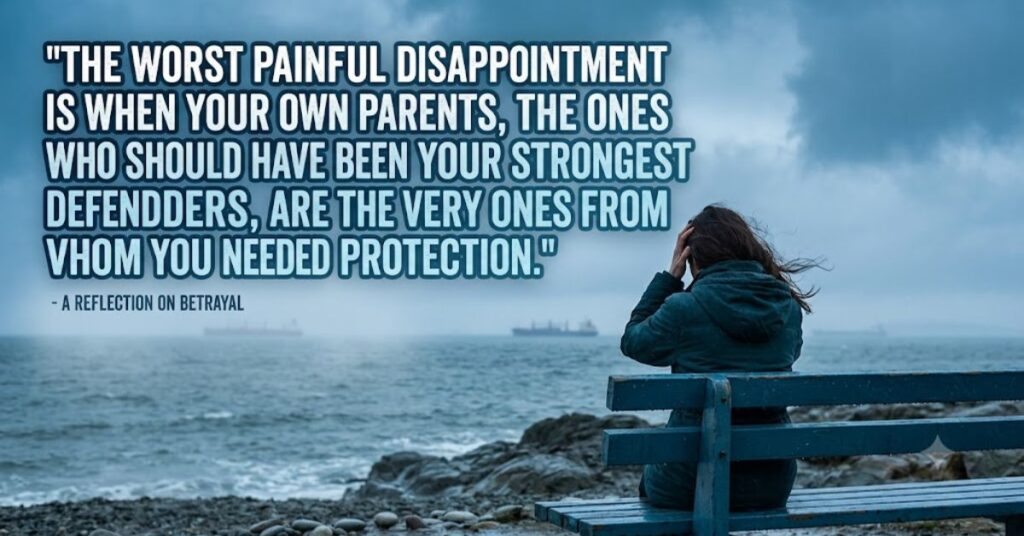
Selfish Bad Parents Quotes And Sayings
Selfish parenting often looks like competition instead of encouragement, control instead of guidance, and image management instead of genuine connection. A selfish parent may show up for the parts of parenting that make them look good, while quietly avoiding the parts that require real sacrifice. These quotes name that pattern clearly, giving language to an experience many adult children were told to just “get over” by relatives who never had to live inside that dynamic themselves and never will.
- “You wanted a mirror, not a child.”
- “Your needs were the only ones that ever counted in our house.”
- “I was raised to serve your image, not my own growth.”
- “A selfish parent measures love by what they get, not what they give.”
- “You showed up for the applause, never for the hard parts.”
- “I learned early that your comfort came before my needs.”
- “Selfishness dressed up as sacrifice is still selfishness.”
- “You loved being called a parent more than being one.”
- “Your convenience always outranked my childhood.”
- “I was raised as an accessory to your life, not the center of it.”
- “You wanted credit for parenting without doing the actual work of it.”
- “I learned to want less, so you’d have to give less.”
- “Your selfishness was never about my worth, only your limits.”
Do Not Take It Personally
A parent’s dysfunction is a reflection of their own unresolved pain, not a verdict on your worth. Understanding this distinction is one of the hardest but most freeing parts of healing. Their coldness, anger, or absence says everything about their limitations and nothing about your value as a person. Repeating this truth to yourself, especially in moments of self-doubt, can slowly rewire the false beliefs a difficult childhood may have planted, replacing them with a steadier, more accurate sense of your own worth over time.
- “Their inability to love you well says nothing about your worth.”
- “You weren’t hard to love; they were incapable of loving well.”
- “Don’t inherit their brokenness as if it were your identity.”
- “Their limitations were never a measure of your value.”
- “You were a convenient target, not a deserved one.”
- “Their coldness was about their history, not your character.”
- “Stop auditioning for love that was never yours to earn.”
- “A bad parent’s criticism is not a reliable review of who you are.”
- “Their failures were written long before you ever arrived.”
- “You don’t have to accept a verdict from someone who never showed up.”
- “Their inability to show love says more about their past than your present.”
- “You are not the sum of someone else’s shortcomings.”
- “Their limitations were set long before you ever entered the picture.”
Bad Parents Quotes / Messages From Daughter And Son
Adult children often carry messages they never got to say out loud — the confrontations that never happened, the questions that were never answered. These quotes give voice to what many sons and daughters have felt but couldn’t articulate: the confusion, the longing, and eventually the acceptance that closure sometimes has to come from within rather than from an apology that may never arrive, no matter how patiently or how long it’s waited for.
- “I spent my childhood earning love that should’ve been free.”
- “You were my first heartbreak, and I didn’t even understand yet.”
- “I learned to parent myself because you were too busy being the child.”
- “Dad, I needed presence, not just a paycheck.”
- “Mom, I needed comfort, not competition.”
- “I stopped waiting for your apology and started writing my own ending.”
- “You raised a survivor instead of a child, and I’m still recovering.”
- “I forgave you for me, not for you.”
- “I grew up fast because staying small wasn’t safe in your house.”
- “This is the letter I never sent, but always needed to write.”
- “I carried the weight of your choices into my own adulthood.”
- “You’ll never read this, but I needed to say it anyway.”
- “I became the parent I needed, since you never quite managed it.”
Focus On Your Own Parenting (If Applicable)
If you’re a parent yourself, breaking the cycle you grew up in can be one of the most healing acts available to you. Every time you choose patience over the anger you inherited, or presence over the distance you experienced, you’re rewriting your family’s story. It won’t be perfect, and old patterns may resurface under stress — but the intention to do better matters, and your children will feel the difference over time, even on the days it feels like you’re failing at it completely.
- “I am breaking a cycle my children will never have to survive.”
- “My kids will know safety, because I never did.”
- “I parent from healing now, not from the wounds I inherited.”
- “Every calm response I give is a rebellion against my own upbringing.”
- “I choose connection over control, on purpose, every day.”
- “My children get the parent I always needed.”
- “Breaking the cycle is exhausting, but so was living inside it.”
- “I am the last generation of this particular pain.”
- “My children will remember safety where I remember fear.”
- “Healing myself is the best inheritance I can leave them.”
- “I repair after every mistake instead of pretending it never happened.”
- “My children’s calm nervous systems are proof the cycle is finally breaking.”
- “I am proof that the cycle can end in one generation.”
Inspirational Parenting Quotes
Not every quote about parenting has to focus on pain. These inspirational lines highlight what good parenting can look like, offering a hopeful contrast and a roadmap for anyone determined to raise children differently than they were raised. They’re a reminder that love, patience, and presence are choices made daily, not personality traits some people simply lack, and that any parent willing to grow and reflect can still build something genuinely better for the next generation.
- “The best parents give roots and wings in equal measure.”
- “Children remember how you made them feel, long after the words fade.”
- “Presence is the most valuable gift a parent can give.”
- “Good parenting is a thousand small moments of showing up.”
- “Love your child louder than you correct them.”
- “A patient parent raises a confident child.”
- “The safest home a child can have is one built on consistency.”
- “Great parenting isn’t about perfection, it’s about repair.”
- “A child who feels heard grows into an adult who feels secure.”
- “Small, steady love outperforms grand, inconsistent gestures every time.”
- “The best inheritance a parent can give is emotional safety.”
- “Children thrive less on perfect parents and more on present ones.”
- “The best parenting advice is simple: show up, and keep showing up.”
Dealing With Bad Parents
Dealing with a difficult parent long-term requires a strategy, not just willpower. Decide in advance what topics are off-limits, how long you’ll stay at gatherings, and what your response will be to common manipulation tactics like guilt-tripping or minimizing. Consistency is key — a boundary you enforce sometimes teaches a toxic parent that pushback eventually works. Give yourself permission to protect your peace even during holidays, milestones, and family events, without feeling obligated to explain your reasoning to anyone who questions it.
- “Consistency in your boundaries is the only language they’ll eventually respect.”
- “You can attend the dinner without absorbing the dysfunction.”
- “Plan your exit before you walk through the door.”
- “Every interaction is optional, even with family.”
- “You are allowed to leave a conversation that turns cruel.”
- “Protecting your peace isn’t dramatic, it’s necessary.”
- “A short, calm visit beats a long, chaotic one.”
- “You get to decide how much access they have to your life.”
- “Their comfort is not more important than your safety.”
- “You can keep the relationship small enough to survive it.”
- “You are not required to attend every event just because you’re invited.”
- “Managing contact deliberately is not the same as being unkind.”
- “You can love from a distance and still call it love.”
Acknowledge The Reality Of Your Situation
Denial keeps people stuck in unhealthy patterns far longer than the truth ever could. Acknowledging that your parent caused real harm — even while acknowledging complicated love — is not disloyalty. It’s the foundation healing is built on. Naming the reality clearly, without minimizing or exaggerating it, allows you to make informed decisions about the relationship going forward instead of reacting out of guilt or fear, which often keeps people trapped in the same painful patterns for years longer than necessary.
- “Naming the harm is not betrayal, it’s honesty.”
- “You can love someone and still admit they hurt you.”
- “Acknowledging reality is uncomfortable, denying it is worse long-term.”
- “The truth about your childhood deserves to be spoken plainly.”
- “You don’t have to protect their image at the cost of your healing.”
- “Facing reality is the first real step out of the fog.”
- “Clarity is painful, but it’s also freeing.”
- “You survived something real; stop minimizing it to keep the peace.”
- “Truth doesn’t require their agreement to still be valid.”
- “Your memory of what happened is allowed to be trusted.”
- “The fog clears the moment you stop excusing what actually happened.”
- “You are allowed to see your childhood clearly, even if it hurts.”
- “Seeing it clearly is the only way to finally set it down.”
Practice Self-Care And Self-Love
Self-care after a difficult childhood is more than bubble baths — it’s therapy, rest, nourishing relationships, and learning to speak to yourself with kindness instead of the criticism you absorbed growing up. Self-love means treating yourself the way a good parent would have: with patience, encouragement, and unconditional acceptance. It’s a daily practice, not a one-time fix, and it’s one of the most powerful tools for breaking generational pain, especially on days when old wounds feel closer to the surface than usual and harder to ignore.
- “Self-care is the parenting you give yourself now.”
- “Speak to yourself the way you always needed to be spoken to.”
- “Rest is not selfish, it’s repair.”
- “You are allowed to nurture the child you used to be.”
- “Self-love is the antidote to a childhood that withheld it.”
- “Protect your energy the way no one protected your childhood.”
- “Healing includes celebrating yourself, loudly and often.”
- “You deserve the gentleness you never received.”
- “Taking care of yourself is not a luxury, it’s overdue.”
- “Every act of self-kindness rewrites an old, unkind message.”
- “You get to reparent yourself with the patience you were denied.”
- “Choosing rest over guilt is its own form of healing.”
- “The love you give yourself now is never too late to start.”
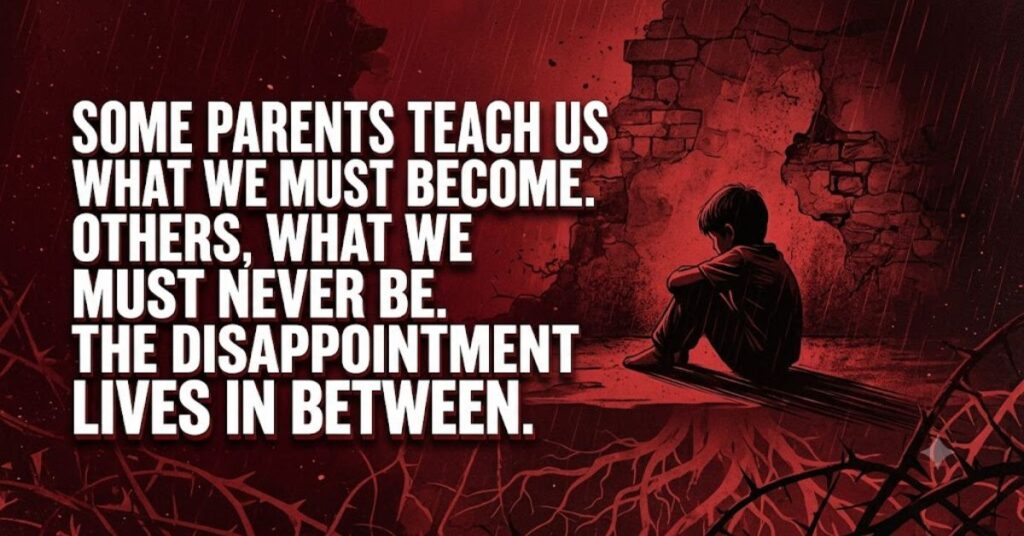
Selfish Fathers Quotes
A selfish father often prioritizes his career, hobbies, ego, or comfort over genuine involvement in his children’s lives. He may show up physically while remaining emotionally absent, leaving children to interpret his distance as their own failure to earn his attention. These quotes speak to that particular ache — wanting a father’s approval that never quite arrives, no matter how much is accomplished, and eventually learning to release the need for it altogether and define success on your own terms.
- “You were in the house, but never really in my life.”
- “I chased your approval longer than you ever chased my attention.”
- “A selfish father teaches his son that love is conditional and rare.”
- “You gave me your name but rarely your time.”
- “I learned to stop needing you long before I stopped wanting to.”
- “Your absence taught me more discipline than your presence ever did.”
- “I stopped waiting at the door for a father who wasn’t coming.”
- “You called it busy; I called it absent.”
- “I inherited your name, not your attention.”
- “I built my confidence without the applause you never gave.”
- “You were present for your own goals, absent for mine.”
- “I stopped measuring my worth by a father who never measured it either.”
- “A father’s silence taught me to speak louder for myself.”
Set Realistic Expectations
One of the most freeing shifts in dealing with a bad parent is lowering expectations to match their actual, demonstrated behavior — not their potential or your hope for them. Realistic expectations protect you from repeated disappointment, because you stop expecting warmth from someone who has never consistently shown it. This isn’t pessimism; it’s self-protection rooted in pattern recognition, and it frees up emotional energy that was previously spent hoping for a change that history strongly suggests may never come at all.
- “Expect what they’ve shown you, not what you hope they’ll become.”
- “Hope is healthy until it becomes a setup for disappointment.”
- “Lower the bar to match their actual behavior, not their potential.”
- “You can’t be let down by expectations you never set too high.”
- “Realistic expectations protect your heart from repeated ambush.”
- “Stop expecting roses from someone who’s only ever grown thorns.”
- “Base your expectations on patterns, not promises.”
- “Protect your peace by expecting exactly what history has shown you.”
- “Their track record is the most honest forecast you’ll get.”
- “Adjusting expectations isn’t giving up, it’s growing up.”
- “Expecting less from them often means demanding more from yourself.”
- “Realistic expectations are simply respect for the facts of the relationship.”
- “Expecting less from them can mean expecting so much more from your own life.”
FAQ’s
What are bad parents quotes?
Bad parents quotes are short sayings that describe the pain, humor, or lessons that come from having a toxic, neglectful, or selfish parent. They validate real experiences of adult children and give language to feelings that are often hard to explain to others who didn’t share a similar upbringing.
Why do people search for bad parents quotes?
People search for these quotes to feel understood, put words to complicated emotions, and find validation that their childhood experiences were real. Many also use them for journaling, therapy sessions, or social media captions when processing their past.
Can bad parents quotes help with healing?
Yes. Reading relatable quotes can be a first step toward processing suppressed emotions, often leading people toward therapy, journaling, or open conversations about their past that they’d previously avoided out of guilt or fear.
Are bad parents quotes disrespectful to family?
No. Acknowledging harm isn’t the same as holding a grudge. These quotes focus on honesty and healing, not disrespect or revenge toward family members, and can coexist alongside genuine love for a parent.
How can I use bad parents quotes?
Use them for journaling, therapy sessions, social media captions, or simply as a private reminder that you’re not alone in what you experienced growing up, whatever form that experience took in your family.
Do bad parents quotes work for both toxic mothers and fathers?
Yes, this collection includes quotes specific to selfish mothers, selfish fathers, and general toxic parenting, so you can find lines that match your exact experience, whether it involved one parent or both of them.
Is it normal to feel guilty relating to these quotes?
Yes, guilt is common even when the feelings are valid. Acknowledging harm doesn’t mean you don’t love your parent; both feelings can coexist honestly without canceling each other out over time.
Can these quotes help if I’m a parent trying to do better?
Absolutely. Several sections, including self-aware “I am a bad parent” quotes, are designed to help parents reflect honestly and break generational cycles before those patterns repeat with their own children.
Should I share these quotes with my parents directly?
That depends on your relationship and personal safety. Some people share quotes to open dialogue, while others keep them private for personal reflection, and both approaches are entirely valid choices to make.
Where can I find more support beyond quotes?
Therapy, support groups, and trusted friends offer deeper support than quotes alone can provide. Quotes are a helpful starting point, not a replacement for professional help when childhood trauma runs deep.
Conclusion
Bad parents quotes give language to an experience that’s often silenced, misunderstood, or minimized by others. Whether you needed a funny line to lighten the weight, a sad quote to validate your grief, or practical guidance on setting boundaries and building a chosen family, this collection of 355 bad parents quotes and sayings was built to meet you where you are. Healing from a difficult parent isn’t linear, and it doesn’t require their participation or cooperation. Focus on what you can control, protect your peace, and remember: acknowledging the truth about your childhood is not disloyalty — it’s the first honest step toward the life you deserve and the relationships you choose from here forward.